Best Eye Sunscreen SPF 50 Options for Daily UV Protection
If you want SPF 50 protection near your eyes, choose a sunscreen whose label says it is suitable for that area; avoid getting any sunscreen in your eyes. The products below include two face sunscreens labeled SPF 50 and three eye-area products with SPF 35 or SPF 40, so none of the listed eye creams provides SPF 50. Supergoop! is best for a tinted eye-area formula, while CeraVe and La Roche-Posay are SPF 50 options for the face. Check product directions before applying near the eyes.
| Product | Listed SPF | Best suited for |
|---|---|---|
| Supergoop! Bright-Eyed | 40 | Tinted under-eye coverage |
| CeraVe Invisible Mineral | 50 | Face sunscreen with an invisible finish |
| QIUFSSE Mineral Eye Cream | 35 | Eye-area color correction |
| Colorescience Total Eye | 35 | Mineral eye-area coverage in multiple shades |
| La Roche-Posay Anthelios Mineral | 50 | Face and body mineral sunscreen |
Supergoop! Bright-Eyed Mineral Eye Cream SPF 40
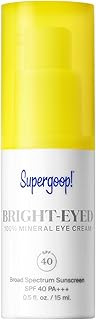
Best for shoppers who want a dedicated under-eye product with mineral protection and a brightening tint. The listed formula uses non-nano zinc oxide and provides broad-spectrum SPF 40. Its soft pink tint is described as illuminating tired-looking eyes and creating a smooth base for concealer or eye makeup.
Choose this if an eye-focused cream and cosmetic finish matter more than reaching SPF 50. The key limitation is its SPF: it does not meet a request for SPF 50. The product information also does not establish that it should be applied directly to eyelids, so follow its label directions and keep it out of the eyes.
CeraVe Invisible Mineral Sunscreen SPF 50

Best for people seeking an SPF 50 mineral sunscreen for the face with an invisible finish. The product listing describes broad-spectrum UVA/UVB protection, fragrance-free and noncomedogenic characteristics, and suitability for sensitive and acne-prone skin. It is also described as a hydrating makeup primer.
Choose this if SPF 50 and a no-white-cast finish are priorities. The listing says to shake well and apply to the face and neck before sun exposure, but it does not specifically identify this as an eye cream. Avoid assuming it is suitable for the eyelids or immediate eye area; use it there only if its packaging directions permit.
QIUFSSE Mineral Sunscreen Eye Cream SPF 35

Best for buyers who want an eye-area product that combines sunscreen with a concealer-like finish. Its listed features include broad-spectrum SPF 35 and a light shade intended to brighten or correct the appearance of dark circles and uneven tone. The product is presented as a three-in-one under-eye cream, sunscreen, and makeup product.
This may suit someone who prefers a tinted eye product rather than a separate sunscreen and concealer. Its important limitation is SPF 35, not SPF 50. Claims about puffiness, fine lines, and dark circles are product-listed benefits, not guaranteed outcomes.
Colorescience Total Eye 3-in-1 Renewal Therapy

Best for shoppers looking for mineral eye-area protection alongside color correction. The listed specifications are SPF 35, PA+++, and 100% mineral UVA/UVB protection. The product is described as immediately brightening and correcting dark circles and is offered in four shades.
Choose this if shade selection and an eye-focused mineral formula are priorities. It is not an SPF 50 option, so it may not match a strict SPF 50 requirement. Check the product label for application directions and use enough sunscreen for the labeled protection.
La Roche-Posay Anthelios Mineral SPF 50

Best for people who want SPF 50 mineral sunscreen for both face and body. The listed formula contains zinc oxide and titanium dioxide and offers broad-spectrum UVA/UVB protection. It is described as oil-free, non-greasy, travel-sized, and designed to blend easily to a soft finish.
Choose this if broad face-and-body use is more important than having a tinted eye cream. Although the listing identifies it as a facial sunscreen, it is not specifically an eye cream. Avoid applying it close to the eyes unless the label says that use is appropriate; sunscreen can irritate eyes if it gets into them.
Buying Guide: Choosing Sunscreen for the Eye Area
Does the product need to be SPF 50?
For a strict SPF 50 requirement, the listed options are CeraVe and La Roche-Posay. The three products specifically marketed for the eye area are SPF 35 or SPF 40. SPF indicates protection against sunburn from UVB; broad-spectrum labeling indicates UVA and UVB protection. Compare the exact SPF and label claims rather than treating these products as interchangeable.
Should you choose an eye cream or face sunscreen?
An eye-area product may offer a tint or makeup-friendly finish and be designed for use under the eyes. A face sunscreen can provide the requested SPF but is not automatically appropriate for eyelids or the immediate eye area. Follow package directions, avoid direct contact with eyes, and stop use if irritation occurs.
What formula and finish should you compare?
Mineral formulas in this selection list zinc oxide, titanium dioxide, or both. Consider whether you prefer a tinted product for visible coverage or an untinted face sunscreen. If white cast, fragrance, or makeup layering matters, compare the product’s stated finish and formula features; results can vary by skin tone and application.
How should sunscreen be used?
Follow the label for the amount, timing, and reapplication instructions. Apply sunscreen generously to the areas specified on its packaging, and use additional sun-protective measures such as shade and sunglasses. Do not rely on a small amount of tinted eye cream to cover a larger area unless its directions support that use.
Frequently Asked Questions
Is any listed eye cream SPF 50?
No. The listed eye-area products provide SPF 35 or SPF 40. The two SPF 50 products are face or face-and-body sunscreens, not products specifically identified as eye creams.
Which option is best for tinted under-eye coverage?
Supergoop! Bright-Eyed is described as a soft pink-tinted eye cream, while QIUFSSE and Colorescience list brightening or color-correcting features.
Can face sunscreen be used around the eyes?
Use it near the eyes only if the product label permits that application. Keep sunscreen out of the eyes, since contact may cause irritation.
What does broad-spectrum sunscreen mean?
Broad-spectrum sunscreen is labeled to protect against both UVA and UVB rays. Check the individual product packaging for its current directions and protection claims.