Best Retinol and Vitamin C Creams and Treatments for American Buyers
The best-supported retinol and vitamin C option in this list is Paula’s Choice CLINICAL 1% Retinol Face Treatment, which explicitly includes both ingredients along with peptides and hydrating hyaluronic acid. APLB also lists retinol, vitamin C, and vitamin E in one facial cream. The other selections can help shoppers compare retinol-focused and vitamin C-focused formulas, but their supplied product details do not confirm both actives in the same product.
| Product | Best For | What The Details Confirm |
|---|---|---|
| Paula’s Choice CLINICAL 1% Retinol | Shoppers seeking a combined formula | Retinol, vitamins C and E, peptides, hyaluronic acid |
| APLB Retinol Vita Cen Cream | Those preferring a cream texture | Retinol, vitamin C, vitamin E, centella complex |
| Paula’s Choice 0.3% Retinol + Bakuchiol | Retinol-focused routine builders | Retinol and bakuchiol in the product name |
| Olay Vitamin C MAX Moisturizer | Vitamin C-focused moisturizing | Vitamin C, niacinamide, peptides |
| Retinol Complex Face Serum | Retinol-focused serum shoppers | Retinol-focused claims; vitamin C not specified |
Paula’s Choice CLINICAL 1% Retinol Face Treatment

Best for: Buyers who want a single treatment listing retinol and vitamin C together. The product details specify 1% retinol, antioxidant vitamins C and E, hyaluronic acid, and peptides. The brand describes it as targeting the appearance of wrinkles, pores, and post-acne marks, and says it suits normal, combination, dry, and oily skin.
It is a stronger retinol-focused choice than a basic vitamin C moisturizer, with additional hydrating and skin-conditioning ingredients in its formula. Choose this if a combined retinol-and-vitamin-C treatment is your priority. The listed directions recommend nighttime use.
Limitation: The 1% retinol concentration may be too strong for someone seeking a low-strength starting point. The supplied details do not provide a specific frequency for beginners.
APLB Retinol Vita Cen Facial Cream
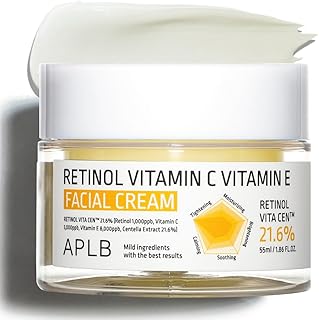
Best for: Shoppers looking for a cream-format product that lists retinol, vitamin C, and vitamin E. Its supplied summary gives ingredient amounts in parts per billion and identifies centella asiatica extract at 21.6%, alongside a centella complex containing madecassic acid, asiaticoside, and asiatic acid.
This is a relevant option for buyers who prefer a facial cream and want both retinol and vitamin C named in the same product. The listing describes it as hydrating and intended to improve skin texture. Its centella ingredients distinguish it from the peptide-and-hyaluronic-acid approach of the Paula’s Choice 1% treatment.
Limitation: The product summary does not explain the meaning of “21.6%” in the product name beyond listing the centella extract percentage, so compare the full ingredient label if exact active concentrations matter.
Paula’s Choice 0.3% Retinol + Bakuchiol Serum

Best for: Buyers comparing retinol strengths or seeking a retinol-and-bakuchiol serum. The product name specifies 0.3% retinol and 2% bakuchiol. Those details make its retinol concentration lower than the 1% treatment above, while still identifying it as a retinol-focused choice.
Choose this if you want to prioritize retinol and bakuchiol rather than insist on a confirmed retinol-plus-vitamin-C formula. The supplied product information does not list vitamin C as an ingredient, so it should not be treated as a verified combined treatment based on these details alone.
Limitation: The provided features are limited to the product name; they do not specify usage directions, skin types, or additional ingredients.
Olay Vitamin C MAX Face Moisturizer

Best for: Shoppers seeking a vitamin C-focused moisturizer for hydration and tone concerns. The supplied name lists vitamin C, niacinamide, and peptides, and describes the product as a brightening face moisturizer intended to even tone and address the appearance of dark spots and hyperpigmentation.
This can complement a separately chosen retinol product in a routine, but the provided details do not say that it contains retinol. Select it for the vitamin C moisturizer category, not as a confirmed all-in-one retinol and vitamin C cream.
Limitation: Retinol is not listed in the supplied product information, so buyers seeking both actives in one formula should verify the current ingredient label.
Retinol Complex Face Serum

Best for: Buyers interested in a retinol-focused serum marketed for anti-aging, brightening, firming, and smoothing. The product name identifies it as a 30 ml retinol complex face serum, making it a comparison option for those considering a serum rather than a cream.
The supplied information does not list vitamin C or provide the retinol concentration. Choose it only if you are comparing retinol-oriented products and plan to check the complete ingredient information before purchase. It is not confirmed as a combined retinol and vitamin C formula by the details provided.
Limitation: Ingredient amounts and specific supporting ingredients are not included in the supplied features.
Buying Guide: How To Choose A Retinol And Vitamin C Product
Does the product list both ingredients?
Check the product’s current ingredient label rather than relying only on a broad claim such as “brightening” or “anti-aging.” In this selection, Paula’s Choice CLINICAL 1% Retinol and APLB Retinol Vita Cen explicitly name both retinol and vitamin C. The other products have details that identify one active category or do not provide enough ingredient information to confirm both.
Should you choose a cream or a serum?
A cream may suit buyers who prefer a moisturizer-style step; APLB is listed as a facial cream. A serum or treatment may appeal to someone building a targeted routine; both Paula’s Choice retinol products are described as treatments or serums. Texture alone does not establish strength or suitability, so compare the ingredient list and directions.
How should retinol strength affect your choice?
The listed Paula’s Choice options provide a clear concentration comparison: 1% retinol versus 0.3% retinol. A higher concentration is not automatically the right choice for every skin type or experience level. If you are new to retinol or prone to irritation, consider a cautious approach and follow the product directions. The APLB and Retinol Complex listings do not provide a directly comparable retinol percentage in their supplied details.
Can retinol and vitamin C be used in the same routine?
Follow each product’s directions and introduce active products carefully. The Paula’s Choice 1% treatment listing recommends nighttime use. Avoid adding several new active products at once, which can make it harder to identify the cause of irritation. Use daytime sun protection as part of a skincare routine, especially when using retinol.
Frequently Asked Questions
Which listed product clearly combines retinol and vitamin C?
Paula’s Choice CLINICAL 1% Retinol lists retinol and vitamins C and E. APLB Retinol Vita Cen also lists retinol, vitamin C, and vitamin E in its supplied product summary.
Does the Olay Vitamin C MAX moisturizer contain retinol?
The supplied Olay details list vitamin C, niacinamide, and peptides, but do not list retinol. Check the current ingredient label if retinol is essential.
Which listed Paula’s Choice option has the lower retinol concentration?
The Paula’s Choice CLINICAL serum with 0.3% retinol has a lower stated concentration than the CLINICAL 1% treatment.
Can I use a vitamin C moisturizer with a separate retinol product?
Some routines use separate products, but follow each product’s directions and introduce actives gradually. Ask a dermatologist for personalized advice if you have sensitive skin or concerns about irritation.
Are all five products confirmed retinol-and-vitamin-C formulas?
No. The supplied details confirm both ingredients for the Paula’s Choice 1% treatment and APLB cream. The other three listings do not confirm both ingredients together.